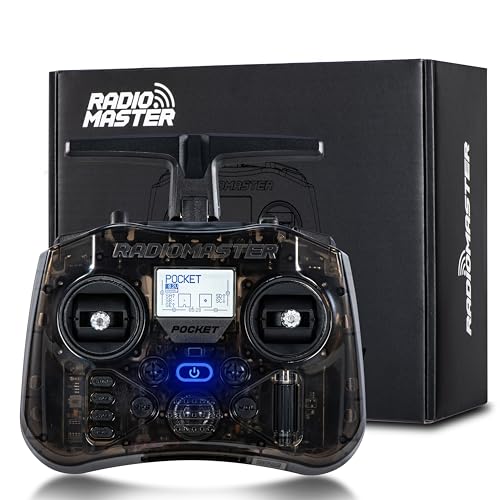
RadioMaster Boxer vs TX16S for FPV and Hobby RC
The RadioMaster Boxer and TX16S both run ExpressLRS and EdgeTX, but they are built for very different pilots. We compare published gimbal specs, channel count, module support, and form factor to help you pick the right radio for FPV or hobby RC.
The Verdict: Boxer for Portable FPV, TX16S for the Full Bench
If you fly mostly FPV quads and want a radio you can throw in a backpack, buy the RadioMaster Boxer. If you want a full-size transmitter with a big color touchscreen and enough switches and sliders to run planes, gliders, and complex models from a desk, buy the RadioMaster TX16S (Mark II). Both run EdgeTX, both come in ExpressLRS versions, and both output up to 16 channels — so the choice is about ergonomics and controls, not raw capability. In one line: for pure FPV quad flying the Boxer is the smarter, cheaper buy; if one radio has to fly everything from a bench, the TX16S earns its size.
Disclosure: Rotor Verdict earns affiliate commissions on qualifying purchases made through our links, per FTC guidelines. This comparison is based on RadioMaster's published specifications and aggregated pilot reviews — no hands-on flight testing is claimed.
No spam. Unsubscribe anytime.
RadioMaster Boxer vs TX16S at a Glance
| Spec | RadioMaster Boxer | RadioMaster TX16S (Mark II) |
|---|---|---|
| Form factor | Gamepad / compact | Full-size tray & handle |
| Weight (no battery) | 532.5 g | ~750 g (V4.0 gimbals) |
| Dimensions | 235 × 178 × 77 mm | 287 × 129 × 184 mm |
| Display | 128 × 64 monochrome LCD | 4.3-inch color IPS touchscreen (480 × 272) |
| Gimbals | V4.0 Hall (AG01 on MAX) | V4.0 Hall (AG01 on MAX) |
| Channels | Up to 16 | Up to 16 |
| Internal RF options | ELRS, 4-in-1 multiprotocol, or CC2500 | ELRS or 4-in-1 multiprotocol |
| External module bay | Standard JR compartment | Standard JR bay |
| Physical controls | Leaner switch set, 2 pots | 6+ switches, 2 pots, 2 sliders |
| Firmware | EdgeTX | EdgeTX |
| Battery | 2× 18650 or 2S LiPo (to 6200 mAh) | 2× 18650 or 21700 |
| Typical price | ~$100–140 | ~$150–250 (variant-dependent) |
| Best for | Portable, thumb-friendly FPV | Multi-discipline RC and complex models |
Specs reflect the current Boxer and the TX16S Mark II. A newer TX16S MK3 (5-inch screen, dual-band) also exists — confirm which generation a listing shows.
Form Factor and Portability
This is the difference you feel first. The Boxer uses a gamepad-style grip, so your thumbs wrap the sticks the way they would on a game controller — a layout most FPV pilots find natural for thumb-flying. At 532.5 g without batteries and 235 × 178 × 77 mm (RadioMaster's published figures), it slips into a backpack without a dedicated radio case.
The TX16S uses the classic full-size tray-and-handle layout. It is larger and heavier — roughly 750 g without batteries in the standard V4.0-gimbal Mark II — which makes it less grab-and-go but more stable on a bench or neck strap during long sessions. Pinch flyers and bigger hands tend to prefer the TX16S tray; freestyle and racing quad pilots gravitate to the Boxer.
Display: Monochrome LCD vs Color Touchscreen
The screens are different classes of hardware, and this is one of the clearest reasons to spend up for the TX16S. The Boxer ships with a 128 × 64 monochrome LCD driven by physical buttons — legible in sunlight and fine for FPV setup, but utilitarian.
The TX16S Mark II carries a 4.3-inch color IPS touchscreen at 480 × 272, plus dual speakers. For anyone who regularly tweaks mixes, telemetry, and logical switches, the touchscreen makes EdgeTX faster to navigate. For a pilot who sets a quad up once and rarely digs into menus, the monochrome LCD is no real handicap.
Gimbals: Both Hall-Effect, Both AG01-Ready
Here is a myth worth clearing up: neither radio has a built-in gimbal advantage. Both the Boxer and the TX16S ship with V4.0 Hall-effect gimbals as standard, and both are offered in MAX editions with RadioMaster's premium AG01 CNC Hall gimbals. In fact, RadioMaster sells the AG01 as a single upgrade kit explicitly for "TX16S & Boxer" — the same gimbal physically fits both radios.
Hall-effect sensing means there are no wiper potentiometers to wear out; stick position is read magnetically for smooth, repeatable centering. If gimbal feel is your priority, the decision is about whether you buy a MAX/AG01 variant, not which model you choose. Not sure which RF and gimbal combo you want on your first radio? Our guide on how to choose an ELRS radio for your first FPV build walks through the trade-offs.
Switches, Pots, and Sliders
With gimbals and channel count tied, physical controls become the real differentiator. The TX16S is built for maximum assignable inputs: six-plus toggle switches, two rotary potentiometers, two side sliders, trims, and a six-position push-button selector. That gives you a physical home for flaps, spoilers, flight modes, gear, gain dials, and more without diving into menus.
The Boxer intentionally carries a leaner set — fewer switches and dials — because a freestyle or racing quad needs only a handful: arm, flight mode, beeper/buzzer, maybe a VTX or turtle-mode toggle. RadioMaster's own comparison notes that "the TX16S Mark II features more switches, dials, and sliders than the Boxer." For simple models that lean layout is a feature; for aircraft needing many discrete controls at your fingertips, the TX16S wins here decisively.
RF and Module Options: More Alike Than You'd Think
Older comparisons overstate the RF gap between these radios; in reality they overlap heavily:
- Channels are equal. Both output up to 16 channels (receiver-dependent). The Boxer is marketed as a 16-channel radio just like the TX16S — there is no 12-channel ceiling on the Boxer.
- Both come in ELRS and 4-in-1 flavors. The Boxer ships with an internal ExpressLRS (1000 Hz capable), 4-in-1 multiprotocol, or CC2500 module; the TX16S Mark II with internal ELRS or 4-in-1 multiprotocol (CC2500/CYRF6936/A7105/NRF2401). Either way, you get ELRS built in or the multiprotocol module for legacy receivers.
- Both have a standard JR module bay. RadioMaster's official spec lists a "Standard JR module compartment" on the Boxer, the same JR-format bay the TX16S uses. So external modules — full-power TBS Crossfire, an external ELRS unit, Tracer, Ghost — mount on either radio, and nano modules fit both with the usual adapter.
The practical takeaway: RF flexibility should not be your deciding factor. Both radios cover essentially every current FPV and hobby-RC receiver ecosystem.
Battery and Run Time
Both radios run on two 18650 cells (not always included) or a 2S LiPo over USB-C, with the Boxer accepting packs up to 2S 6200 mAh for run times RadioMaster cites in the ~20-hour range. Either radio easily outlasts a day's worth of flight LiPos, so battery life rarely decides the purchase.
Which Should You Buy?
Buy the RadioMaster Boxer if:
- Your flying is primarily freestyle or racing FPV quads.
- You want the lightest, most portable radio that travels without a case.
- You prefer a gamepad grip and thumb-flying ergonomics.
- You are happy with a monochrome screen and a lean switch set — and you want to spend less.
Buy the RadioMaster TX16S (Mark II) if:
- You fly, or plan to fly, planes, gliders, or complex multirotors that need many physical switches, dials, and sliders.
- You want the 4.3-inch color touchscreen for faster EdgeTX setup and telemetry.
- You prefer a full-size tray you can rest on a bench or hang from a neck strap for long sessions.
- You want one do-everything radio and don't mind the extra size, weight, and cost.
Prices move with variant and gimbal choice. Browse FPV radio transmitters on Amazon to check current pricing on both RadioMaster models and other ELRS-compatible options. If you're still pricing out the whole rig, our breakdown of what a 5-inch FPV build costs puts the radio spend in context.
Frequently Asked Questions
Is the RadioMaster Boxer or TX16S better for beginners?
For a beginner focused on FPV quads, the Boxer is usually the better first radio: it's lighter, cheaper, and its gamepad layout feels familiar. Those planning to fly airplanes or a mix of aircraft — where extra switches and a color screen speed up setup — are better served by the TX16S. Both run EdgeTX, so the learning curve is identical.
Do the Boxer and TX16S use the same ExpressLRS receivers?
Yes. In their ELRS versions both radios use standard 2.4 GHz ExpressLRS, so they bind to the same ELRS receivers and support the same packet rates. You can move receivers and models between a Boxer and a TX16S. Both also accept external JR-bay modules (Crossfire, external ELRS, Tracer) if you need another protocol.
Does the TX16S have more channels than the Boxer?
No. Both output up to 16 channels, receiver-dependent. Older comparisons sometimes list the Boxer at fewer channels, but RadioMaster markets it as a 16-channel radio. The TX16S's advantage is more physical controls (switches, pots, sliders), not more channels.
Can I upgrade either radio's gimbals to AG01?
Yes. RadioMaster's AG01 CNC Hall gimbals are sold as an upgrade kit that fits both the TX16S and the Boxer, and both radios ship with AG01 gimbals in their MAX editions. Neither model is stuck with lesser gimbals.
Bottom Line
Both are excellent EdgeTX radios with Hall-effect gimbals, up to 16 channels, an ELRS option, and a JR module bay — RF and gimbal capability is effectively a tie. The real split is physical: the Boxer wins on portability, price, and thumb-friendly FPV ergonomics, while the TX16S wins on its color touchscreen, full-size feel, and larger bank of switches, pots, and sliders for complex models. For a 100% FPV quad pilot, the Boxer is the cleaner, cheaper, more practical choice; for a pilot who wants one radio to fly every discipline from a bench, the TX16S is the long-term keeper.
Sources
Affiliate Disclosure